Mastering Scale: The Essential Guide to Google Indexing Checker API
Automating URL Inspection: Solving Enterprise Indexing Challenges
For any enterprise-level SEO project, the "Discovered - currently not indexed" status is a silent traffic killer. When managing thousands of dynamic routes in a Next.js environment, relying on manual GSC checks is impossible due to the 50-URL daily inspection limit. A professional Google index checker API is the only way to gain visibility into your site's true coverage at scale.
Automation allows you to move from guessing to knowing. Instead of wondering why a product launch didn't gain traction, you can perform automated search presence auditing to verify if your new /products/[slug] pages are actually in the database. This data-driven approach ensures your link equity isn't being wasted on invisible URLs.
We recommend integrating programmatic indexing monitoring directly into your CI/CD pipeline. By checking crawl statuses 72 hours after a deployment, you can immediately identify technical blockers like accidental noindex tags or 5xx server errors that Googlebot encountered during discovery.
Logic of Scale: The Mental Model of Automated Verification
Think of this programmatic auditing tool as an automated scout. Just as a scout reports back on whether a bridge is safe to cross, the verification endpoint tells your server whether Google has successfully ingested your content. This is a binary confirmation that triggers the next stage of your SEO strategy.
Analogy: This bulk verification system is like a modern digital concierge that confirms your VIP guests (URLs) have not only arrived at the hotel but have successfully checked into their rooms (the Index).
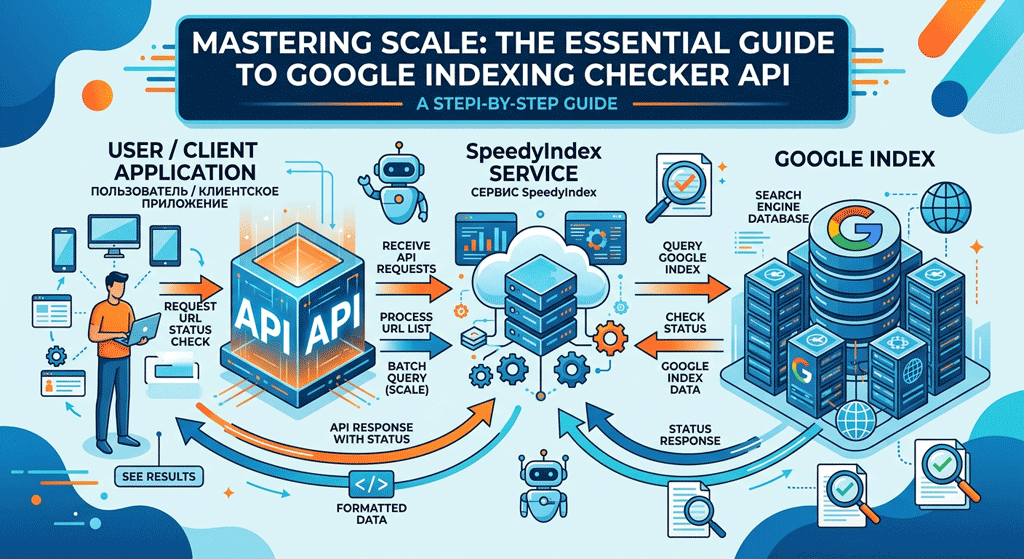
Why SpeedyIndex is the leading Google Search Console API Alternative for 2026
While the native URL Inspection API is limited by strict per-property quotas (often capped at 2,000 requests per day), our RESTful endpoints allow for true enterprise-scale automation. Unlike GSC, which often suffers from a 48-72 hour reporting lag, SpeedyIndex provides a high-throughput architecture for bulk search presence auditing.
- Quota Freedom: Bypass the 50-URL manual limit and property-based API constraints.
- Infrastructure Stability: Powered by a distributed network ensuring 99.9% Uptime for mission-critical SEO workflows.
- Protocol Agnostic: Seamlessly integrate with any stack using standard JSON-RPC logic or REST calls.
Quick Wins vs Long-term SEO Fixes
- Win: Audit your top 500 URLs using a Google index checker to find immediate gaps.
- Win: Update your sitemap.xml to include only 200 OK status codes, removing any 404 or 5xx bloat.
- Win: Use a REST API to automate weekly status reports for new blog posts.
- Win: Check your robots.txt for unintended blocks on high-value JS assets.
- Win: Implement a 301 redirect for any duplicate "discovered" URLs to a single canonical version.
- Win: Increase internal linking from your homepage to the most critical unindexed pages.
- Win: Secure your RESTful endpoints with a unique Bearer Token to automate weekly status reports.
- Win: Implement JSON-RPC batching to check status for multiple Next.js dynamic routes in a single API request.
- Win: Verify SSL/TLS handshake integrity to ensure Googlebot doesn't hit a protocol-level 5xx error.
Long-term: Implement a automated fix for 'Crawled - Not Indexed' by improving content uniqueness and server TTFB across all Next.js routes.
The Practical Workflow to Speed Up Indexing (Step-by-Step)
- Export URLs: Gather all production URLs from your database (e.g., /blog/post-101).
- Filter Status: Ensure all target URLs return a 200 OK server response code.
- API Submission: Use your Google indexing checker API to batch check the current index status.
- Identify Gaps: Focus exclusively on URLs marked with code: 1 (Not found/Not indexed).
- Diagnostic Check: If... URLs are in the sitemap but not indexed, then... check for thin content or duplicate issues.
- Link Injection: Add 2-3 internal links to the missing URLs from already indexed pages.
- Accelerate Discovery: Submit the unindexed batch to the SpeedyIndex indexing service.
- Re-verify: After 5-7 days, run the API check again to confirm successful entry.
Indexing Approaches: Decision Table
| Method | Best for | Expected speed | Risk/Downside | When NOT to use |
|---|---|---|---|---|
| Manual GSC | Single URL fixes | Instant check | 50 URL daily quota | Bulk migrations |
| Standard Sitemap | Fresh site launches | 2-14 days | Very passive | Time-sensitive news |
| Indexing API (G) | Job/Event pages | Fast discovery | Complex setup | Static blog posts |
| SpeedyIndex | Backlinks & SaaS | 24-72 hours | Token cost | Blocked by robots.txt |
| Link Wheels | Spam tiers | Unpredictable | Penalty risk | Safe business sites |
| Ping Services | Small blogs | Variable | Low success rate | Enterprise scale |
Mistakes That Kill Crawlability
- Relying on "site:" queries: This is a sampled view; always use an API for accurate data.
- Ignoring 5xx errors: Googlebot will stop crawling if your Next.js server times out.
- Robots.txt conflicts: Blocking /static/ files that contain critical rendering JS.
- Pagination traps: Endless "Load More" buttons without crawlable anchor tags.
- Missing Canonical Tags: Forcing Google to choose between /page and /page?utm=...
- JavaScript SEO failure: Not providing a pre-rendered HTML version for Googlebot.
- Thin content: Pages with less than 200 words often get the "Discovered - not indexed" tag.
- Sitemap bloat: Including URLs that are already indexed or redirected.
- Broken 404s: Wasting crawl budget on pages that no longer exist.
- Slow TTFB: High Time To First Byte makes Googlebot think your site is unstable.
Bypassing GSC API Limits with SpeedyIndex: Real-Time Mass URL Verification
Deploy mass indexing checks programmatically. Our high-throughput REST API v2 is engineered for SEO agencies requiring bulk URL validation with zero reporting lag.
curl -X POST "https://api.speedyindex.com/v2/task/google/checker/create" \
-H "Authorization: YOUR_API_KEY" \
-H "Content-Type: application/json" \
-d '{
  "urls": [
    "https://example.com/page1",
    "https://example.com/page2"
  ]
}'
import requests
import json

url = "https://api.speedyindex.com/v2/task/google/checker/create"
headers = {
    "Authorization": "YOUR_API_KEY",
    "Content-Type": "application/json"
}
payload = {
    "urls": [
        "https://example.com/page1",
        "https://example.com/page2"
    ]
}

response = requests.post(url, headers=headers, data=json.dumps(payload))
print(response.json())
// Use this for bulk Next.js route verification & mass index auditing
<?php
$ch = curl_init();
curl_setopt($ch, CURLOPT_URL, "https://api.speedyindex.com/v2/task/google/checker/create");
curl_setopt($ch, CURLOPT_RETURNTRANSFER, 1);
curl_setopt($ch, CURLOPT_POST, 1);
curl_setopt($ch, CURLOPT_POSTFIELDS, json_encode([
    "urls" => [
        "https://example.com/page1",
        "https://example.com/page2"
    ]
]));
curl_setopt($ch, CURLOPT_HTTPHEADER, [
    "Authorization: YOUR_API_KEY",
    "Content-Type: application/json"
]);

$result = curl_exec($ch);
curl_close($ch);
echo $result;
?>
Enterprise Feedback on Indexing API
How global SEO teams automate their workflow with SpeedyIndex
"Integrating the Google Indexing Checker API into our dashboard took less than an hour. For a Next.js project with over 50k pages, this is the only way to see real-time URL statuses without GSC limitations. Once we identify dropped links, we push them straight to your Google Indexing Service—it's a flawless technical loop."
"What I love about SpeedyIndex is the transparency. The API clearly shows what's indexed and what isn't. If a URL doesn't make it into the index, the 100% automatic refund kicks in. We stopped paying for 'submission attempts' and started paying for results. Hands down the best ROI for indexing automation."
"Providing accurate reports to our clients is non-negotiable. We use the API for mass-checking thousands of links across multiple domains. No more guessing why traffic is dipping. If we spot an issue, we engage your Backlink Checker for a deep dive into donor health. It’s professional-grade SEO analytics."
"Simply incredible! The API returns indexing statuses instantly. Checking 1,000 links used to take half a day; now, it takes seconds. Your limit of 120 requests per minute allows us to monitor our entire PBN in real-time. Thank you for providing such a stable and reliable REST v2!"
FAQ — Google Indexing & API Automation
A: It completely bypasses the manual daily limits of Google Search Console (GSC), allowing you to check the indexing status of thousands of URLs in a single batch. This is critical for large-scale websites and professional backlink monitoring.
A: We recommend waiting 48–72 hours after content publication. This gives Googlebot sufficient time to discover the page naturally before you perform a programmatic verification check.
A: No. A "200 OK" status only confirms that your web server is responding correctly. Indexation is only confirmed when the search engine returns a specific success code indicating that the URL is present in Google's searchable database.
A: Please verify your Authorization header and ensure your API key is correct. Most common errors stem from failed authentication or an empty token balance on your account.
A: Yes. Unlike tools restricted within Search Console, a professional Google Indexing Checker API can verify any public URL on the internet, making it the perfect tool for auditing your link-building profile.
Documents on the topic of the article
- Google Search Console - Inspecting URLs
- Googlebot Crawling and Indexing Guide
- W3C - HTTP Status Code Definitions
7-Day Indexing Action Plan
- Day 1: Run a site-wide crawl and identify all URLs returning 4xx/5xx errors.
- Day 2: Submit your top 1,000 traffic-driving URLs to the Google indexing checker API.
- Day 3: For all unindexed URLs, update the lastmod date in your XML sitemap.
- Day 4: Strengthen the internal link structure for "discovered" but not indexed pages.
- Day 5: Use SpeedyIndex to trigger a fresh crawl for the missing batch.
- Day 6: Audit your server logs to ensure mobile Googlebot is visiting the target URLs.
- Day 7: Re-run the API check to confirm 100% visibility for your key pages.